

FIDLOCK GmbH
Kirchhorster Str. 39
30659 Hannover
Information
FIDLOCK Consumer Products


Stay up to date with our
newsletter to learn all about
mag(net)ic & innovative
closures for your products!
Ron Zaslaver is an industrial designer working at the intersection of design, engineering and real-world application. His work translates complex interactions into clear, functional systems, and hands-on experience in professional dog training, where control, timing and communication are critical, directly informs his approach.
He begins by observing real-world situations and analysing how people interact with objects “I approach design as a system where materials, forces and behaviour interact in real-world situations,” he explains. By combining industrial design, engineering logic, and user experience, he creates products that simplify complex interactions. Curiosity about how things work drives him, and the most effective products emerge when aesthetics, engineering, and usability are developed together as one integrated process – and that’s where FIDLOCK comes into play.
.
The Project – MODUX:
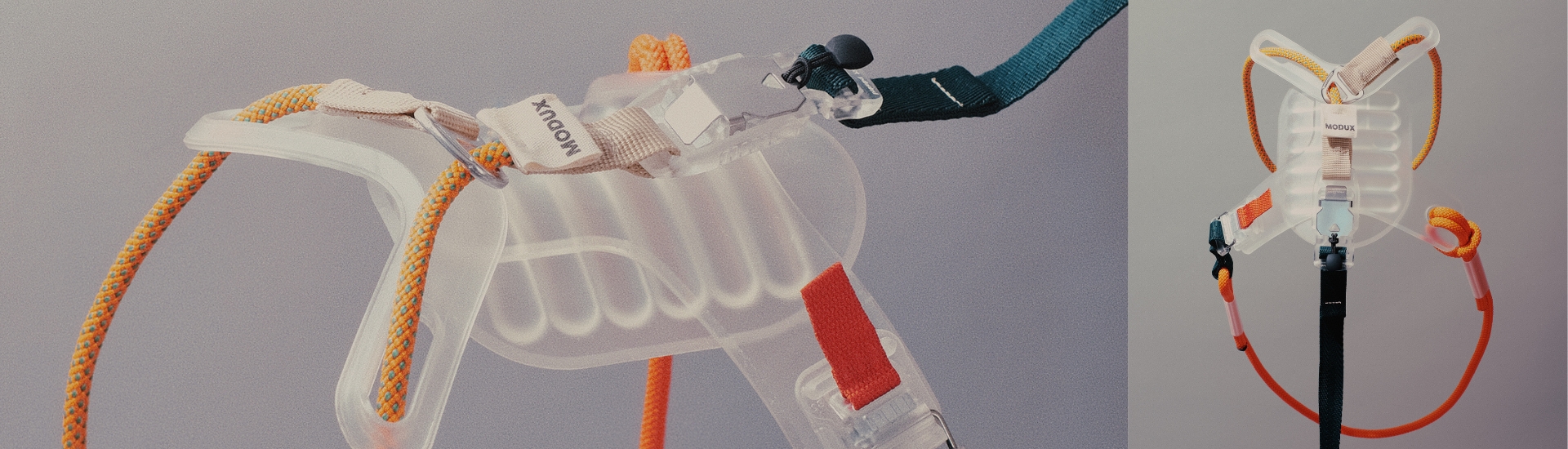
Modular 3D-Printed Dog Harness featuring FIDLOCK fasteners
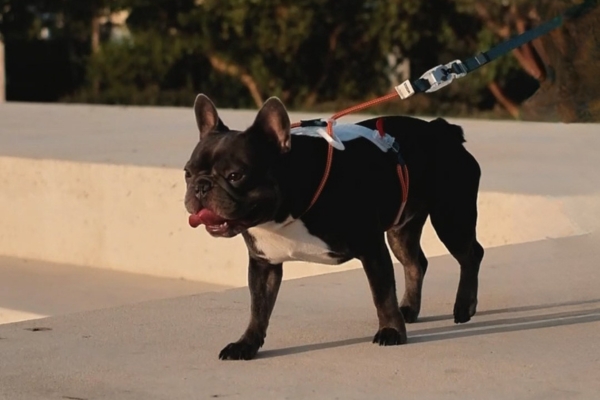
MODUX is an experimental project aimed at improving safety, control, and communication between dog and pet owner in urban environments. The harness uses structural 3D printing to create a lightweight, adaptive system that responds directly to movement and load.
The structure is printed in flexible, durable TPU, allowing it to conform to the dog’s body while maintaining strength and comfort. A modular architecture enables future customisation and size adaptation across different breeds.
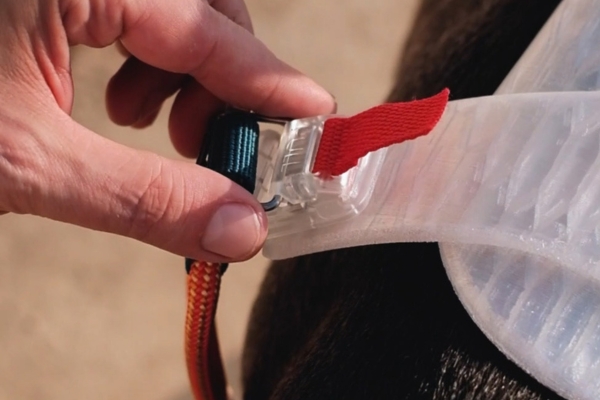
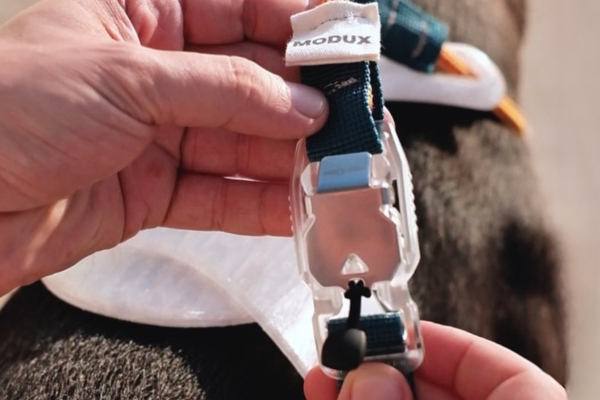
A key element is the integration of a magnetic-mechanical FIDLOCK fastening system, featuring the HOOK and the V-BUCKLE. Both enable fast, precise attachment and release while maintaining consistent performance under load. An integrated collar element provides a built-in control mechanism within the harness system, encouraging clear communication and consistent handling.
HOOK 25 plastic transparentV-BUCKLE 20 transparent
The semi-transparent design highlights the dog’s natural coat, allowing the harness to complement rather than conceal the animal.
The idea behind MODUX was to improve the dynamic interaction between dog and dog walker, enhancing control and safety without adding complexity. Structural 3D printing allows forces to be distributed efficiently while reducing weight and maintaining comfort. “The geometry itself distributes forces, enabling precise control over flexibility, weight, and function,” Zaslaver notes. Features such as handles and attachment points are integrated directly into the structure. Parametric design allows targeted reinforcement of high-load areas while maintaining flexible zones for comfort and freedom of movement.
FIDLOCK fasteners were chosen for their intuitive handling and speed.
“In dog handling, connections must work instantly and under real tension,” he explains. In this project, the HOOK 25 plastic transparent and the V-BUCKLE 20 transparent are used to enable quick, secure and easy handling. Compared to conventional buckles, FIDLOCK fasteners guide the connection automatically, close almost instantly, and maintain strong mechanical resistance. This ensures the leash connection is maximally reliable while the fasteners themselves define structural anchor points and shape how loads transfer through the system.
The biggest challenges were maintaining flexibility while supporting mechanical loads and integrating stable connection points, which required extensive iteration.
Visual design also played a role: the semi-transparent material highlights the dog and creates a distinct product identity.
“Design should highlight the dog while creating a unique product identity.”
Zaslaver sees the MODUX principles as transferable to other products. The combination of structural additive manufacturing and intelligent fastening can enable new modular systems across multiple categories. His advice to designers: integrate the fastener early and treat it as part of the system architecture.
We would like to sincerely thank Ron Zaslaver for the inspiring interview and for sharing insights into his creative process.
To see more of his projects, follow him on Instagram @studiozas__and visit www.ronzaslaver.com.
We’re very much looking forward to his upcoming projects.
His upcoming projects will continue to explore modular systems that respond to real-world use,
combining structural design with intuitive control.
FIDLOCK GmbH
Kirchhorster Str. 39
30659 Hannover